
The Drone Control Layer: How Autonomous Airspace Infrastructure Is Reshaping the Global Economy
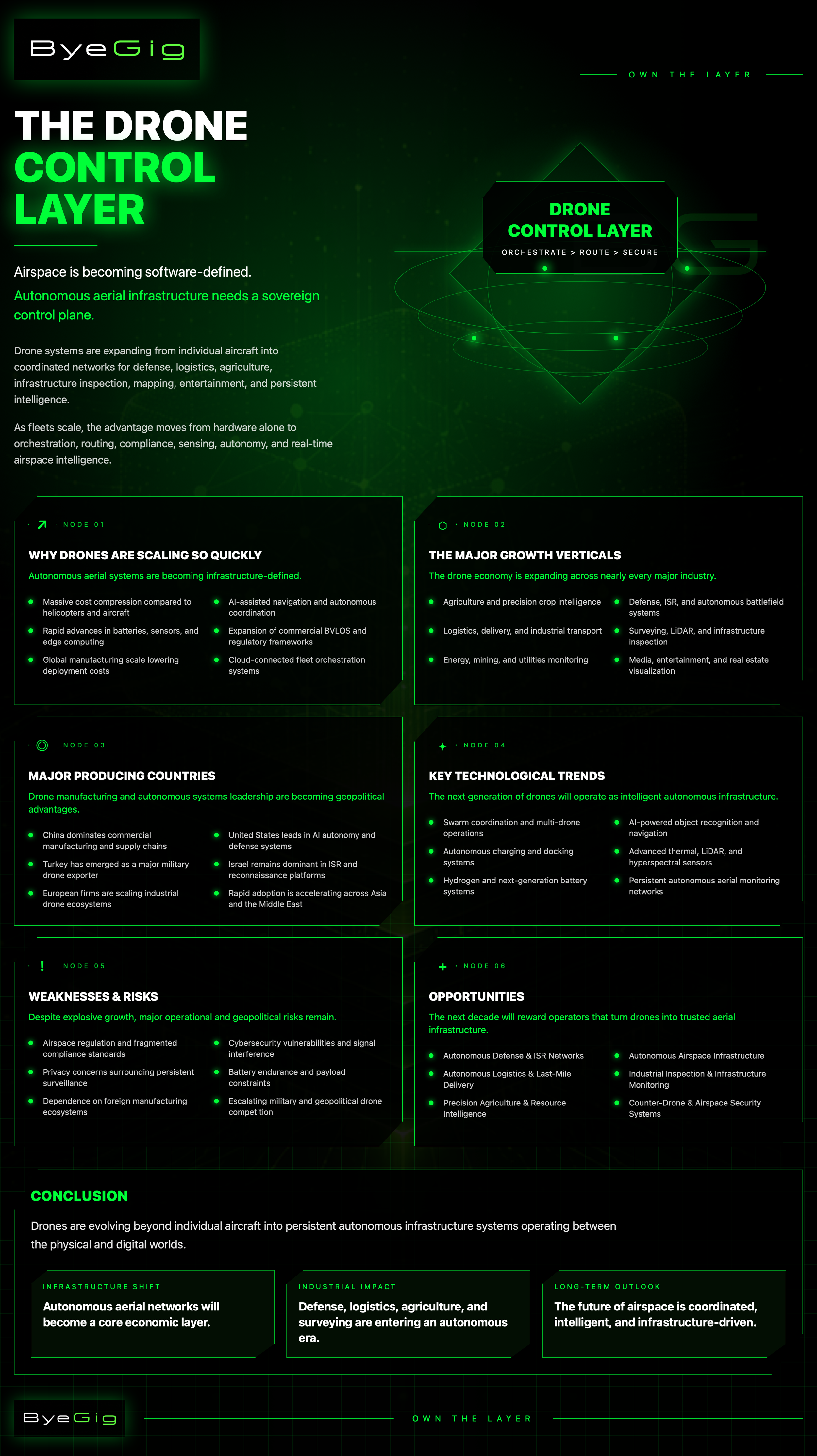
Airspace is rapidly becoming software-defined. What began as a niche aerospace technology has evolved into one of the fastest-growing infrastructure layers in the modern economy, expanding across defense, logistics, agriculture, industrial inspection, surveying, mapping, energy, emergency response, entertainment, and persistent intelligence systems.
The global drone market is projected to grow dramatically over the next decade, with forecasts ranging from approximately $95 billion to more than $260 billion globally by 2030 depending on segment inclusion and methodology. Multiple industry forecasts now project commercial drone markets alone surpassing $50 billion annually by the end of the decade, driven by autonomous operations, AI integration, logistics expansion, infrastructure monitoring, and defense modernization.
The commercial drone ecosystem is already scaling rapidly. According to FAA and industry estimates, more than 850,000 drones are currently registered in the United States, while the global commercial drone market continues expanding across energy, construction, agriculture, and industrial inspection sectors. Drone service markets alone are projected to exceed $109 billion by 2030 with CAGR estimates approaching 30% in some segments.
One of the most important shifts is the emergence of Beyond Visual Line of Sight (BVLOS) operations. Historically, most commercial drone deployments required direct visual oversight by operators, severely limiting scalability. That is now changing. Regulatory frameworks in the United States, Europe, China, and other major economies are increasingly enabling autonomous long-range operations, unlocking entirely new economic models for logistics, inspection, mapping, and coordinated aerial networks. Industry analysts now expect BVLOS operations to become one of the fastest-growing segments of the entire drone economy.
The next phase of growth is being driven by six major categories: autonomous defense & ISR networks, autonomous airspace infrastructure, drone logistics & last-mile delivery, industrial inspection & infrastructure monitoring, precision agriculture & resource intelligence, and counter-drone security systems.
Defense remains one of the most transformative segments. Recent global conflicts have demonstrated how low-cost autonomous aerial systems can fundamentally reshape surveillance, targeting, reconnaissance, and battlefield economics. Countries including the United States, China, Turkey, Israel, and Ukraine are accelerating investments in autonomous drone systems, swarm coordination, ISR platforms, and counter-drone technologies. Military and homeland security applications now account for nearly half of the global drone market in some forecasts.
Commercial logistics is also beginning to move from experimentation toward scalable deployment. Companies including Amazon, Walmart, Zipline, and Alphabet are expanding drone delivery networks across healthcare, retail, industrial supply chains, and remote logistics operations. North America currently leads drone delivery deployment, while Asia-Pacific is projected to become the fastest-growing drone delivery market globally. China’s “low-altitude economy” alone is projected to exceed approximately $200 billion in value within the next several years.
Industrial inspection and infrastructure monitoring may ultimately become one of the largest commercial drone categories. Energy utilities, telecom operators, rail systems, mining operations, offshore infrastructure, and construction firms increasingly rely on drones for LiDAR mapping, thermal analysis, predictive maintenance, and digital twin creation. Some estimates now project inspection and maintenance to become the single largest commercial drone application by 2030, surpassing even agriculture.
Agriculture is simultaneously becoming one of the most important long-term growth drivers. Autonomous spraying, multispectral crop analysis, irrigation monitoring, and precision resource management are rapidly transforming large-scale farming economics. Analysts estimate that more than 30% of large farms globally may already be utilizing drone systems for field operations, with adoption accelerating particularly across China, Southeast Asia, and North America.
At the center of this transition is artificial intelligence. Modern drone systems increasingly integrate computer vision, autonomous navigation, edge AI processing, swarm coordination, object recognition, and real-time aerial analytics. Advances in battery systems, hydrogen propulsion, lightweight materials, autonomous charging, and sensor technologies continue expanding operational range, endurance, and payload capabilities.
The long-term opportunity, however, extends far beyond drones themselves.
The true infrastructure shift lies in the emergence of autonomous aerial coordination systems — the routing, orchestration, sensing, compliance, and operational intelligence layers managing millions of autonomous aircraft simultaneously. As drone fleets scale globally, the competitive advantage increasingly moves away from hardware alone and toward the control layer coordinating these networks in real time.
The future drone economy will not simply be about flying machines.
It will be about persistent autonomous infrastructure operating between the physical and digital worlds — a new global coordination layer for commerce, intelligence, logistics, security, and industrial operations.
